In short
- The spine moves in four basic directions: flexion, extension, lateral flexion and rotation. Most poses combine them.
- Bone shape varies between people, especially at the hips and shoulders. Some limits in range are structural, and no amount of stretching will change them.
- Flexibility (how far a joint can be moved), mobility (how far you can move it under control) and stability (holding it steady) are different qualities. Good practice trains all three.
- Treat alignment cues as principles that protect joints and direct effort, adapted to your body.
Why anatomy matters in yoga
You do not need to memorize muscle names to practice well. A basic picture of how the main joints move, though, helps you understand what a pose is asking for, recognize when you are forcing something, and adapt shapes to your own body. It also makes teachers' cues easier to interpret. When a teacher says "hinge from the hips," you will know which joint is meant and why.
This page covers the areas that matter most in asana practice. It is a general guide, not a medical resource. If you have a specific injury or condition, a physical therapist or doctor can give advice tailored to you. See Practicing Safely for guidance on injuries and conditions.
The spine and its movements
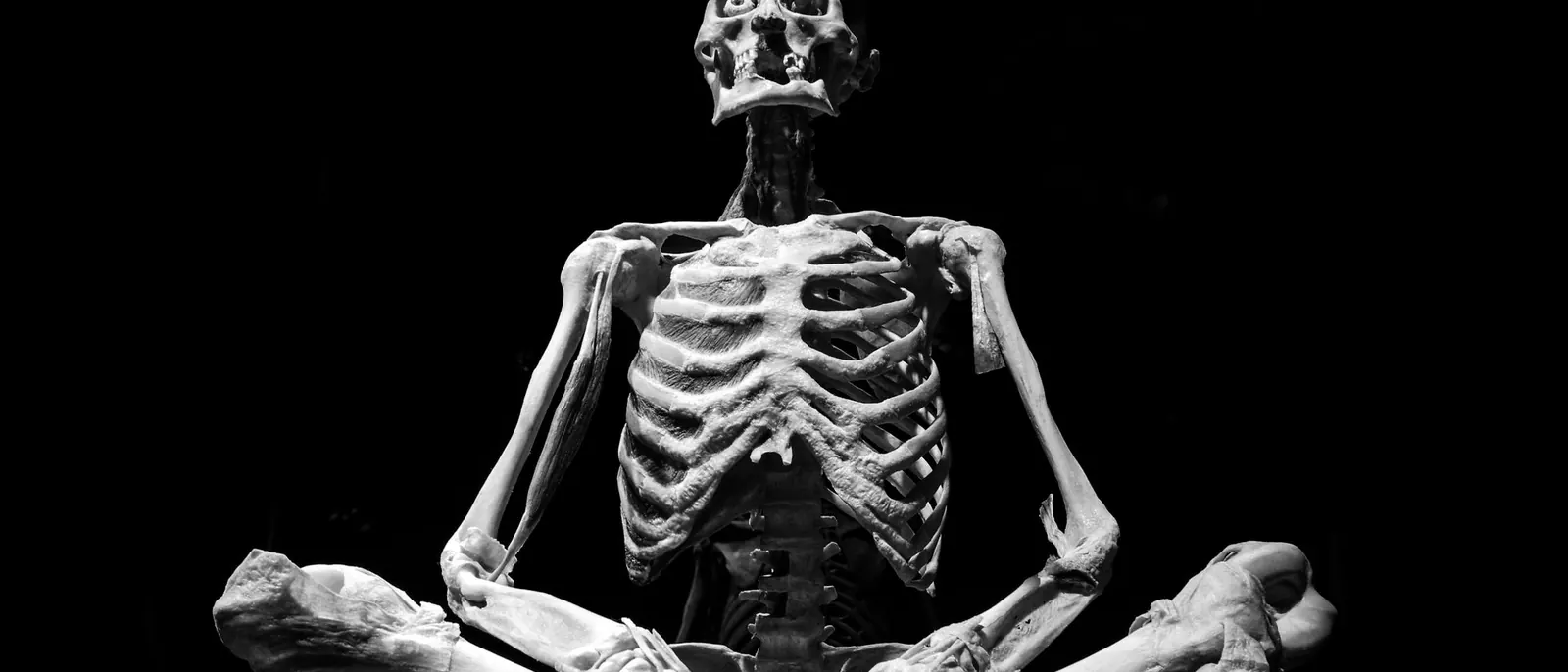
The spine is a column of 24 movable vertebrae (7 cervical in the neck, 12 thoracic in the upper and mid back, and 5 lumbar in the lower back), resting on the sacrum and ending at the tailbone (coccyx). Between most vertebrae sit intervertebral discs, which absorb load and allow movement. Seen from the side, a healthy spine has gentle curves: forward in the neck, backward in the upper back, forward in the lower back. These curves help it absorb shock and carry load.
Each region moves differently. The neck is the most mobile. The thoracic spine rotates relatively well but has limited flexion and extension because it is attached to the rib cage. The lumbar spine flexes and extends readily but rotates very little. This is why twisting should mostly come from the upper back, and why the lower back often ends up doing more than its share in backbends.
Flexion
Flexion is rounding forward, bringing the front of the vertebrae closer together. It happens in Child's Pose, cat pose and rounded forward folds. Gentle flexion is healthy. Loaded or forced flexion, such as pulling hard into a forward fold with a rounded lower back, can strain the discs and is a particular concern for people with osteoporosis.
Extension
Extension is arching back, as in Cobra, Bridge and Camel. Well-distributed backbends spread the curve along the whole spine, with the upper back contributing as much as possible. Most people tend to hinge sharply at the lower back or the neck, so cues like "lengthen before you arch" aim to spread the movement out.
Lateral flexion
Lateral flexion is bending to the side, as in a standing side bend, Triangle and Extended Side Angle. It lengthens the side of the torso, including the muscles between the ribs and pelvis, and is often neglected in everyday life.
Rotation
Rotation, or twisting, turns the vertebrae around the long axis of the spine. It appears in Seated Twist, Reclining Twist and revolved standing poses. Twisting from a lengthened spine allows more rotation than twisting from a slumped one. Avoid using the arms to crank deeper than the spine can go on its own.
Axial extension
Many teachers also refer to axial extension, a gentle lengthening of the spine along its axis, which slightly reduces the curves. It is what cues like "grow tall" or "lengthen through the crown" are asking for, and it is a good starting point for almost every pose.
Pelvis and hips
The pelvis is a ring of bone formed by the two hip bones and the sacrum. It connects the spine to the legs, and its position strongly affects the lower back. When the pelvis tips forward (anterior tilt), the lumbar curve increases. When it tips back (posterior tilt), the lumbar curve flattens. Tight hamstrings tend to pull the pelvis into a posterior tilt when you sit or fold forward, which rounds the lower back. That is the main reason teachers suggest sitting on a folded blanket in Staff Pose or bending the knees in forward folds.
The hip joint is a ball-and-socket joint where the head of the thighbone (femur) sits in a deep socket in the pelvis (the acetabulum). It moves in six directions: flexion (knee toward chest), extension (leg back), abduction (leg out to the side), adduction (leg across the midline), and external and internal rotation. Because the socket is deep and surrounded by strong ligaments, the hip is very stable. Its range varies a great deal between people, partly due to bone shape.
A key idea in forward folds is hip hinging, moving at the hip joint rather than rounding the spine. In Seated Forward Fold or Pyramid Pose, the pelvis tilts forward over the thighs and the spine follows. If the hamstrings are tight, the hinge is small, and that is fine. Rounding to reach further moves the stretch from the hamstrings to the lower back.
Shoulders
The shoulder is not a single joint. It is a complex of the upper arm bone (humerus), shoulder blade (scapula) and collarbone (clavicle), with the scapula gliding over the back of the rib cage. The main ball-and-socket joint has a shallow socket, which gives the shoulder the largest range of any joint in the body but also makes it less stable than the hip. Muscles, especially the rotator cuff, do much of the work of keeping it in place.
When you raise your arms overhead, the shoulder blades need to rotate upward and move slightly outward. Old cues to "pull the shoulders down" in overhead poses can block this natural movement. Many teachers now suggest letting the shoulder blades rise and rotate as the arms go up, while keeping the neck long and the upper arms externally rotated slightly.
In weight-bearing poses such as Downward-Facing Dog, plank and Side Plank, the muscles around the shoulder blade (particularly serratus anterior) need to hold it against the ribs. The cue to "push the floor away" asks for this. In chaturanga, lowering the chest below elbow height with elbows splayed puts high load on the front of the shoulder, a common source of irritation.
Knees
The knee is mainly a hinge. It bends and straightens, and it allows a small amount of rotation only when bent. It relies on ligaments and two crescent-shaped cartilages, the menisci, for stability. Because the knee sits between the hip and ankle, stiffness at either end tends to push strain into it.
The most common example is cross-legged sitting and lotus. If the hip cannot rotate outward enough, the rotation is forced at the knee, where the joint is poorly designed to provide it. Knee pain in these positions is a signal to add height under the hips, support the knees, or choose a different seat. In lunges and Warrior II, keeping the front knee tracking roughly over the middle toes and above or behind the ankle distributes load evenly. In Hero Pose, sitting on a block reduces the depth of knee flexion.
A related issue is hyperextension, where the knee straightens past neutral and appears to bow backward. Some people are built this way. In standing poses, a micro-bend or the cue to lift the kneecaps while pressing through the foot helps keep the knee in a supported position.
Core
In yoga, "core" usually refers to the muscles that wrap around and support the trunk: the deep transverse abdominis, the obliques, the rectus abdominis (the "six-pack" muscle), the back extensors, the pelvic floor and the diaphragm. Together they create a pressurized, adaptable cylinder that transfers force between the legs and arms and supports the spine during movement.
A functional core is coordinated and responsive, able to adjust its effort to the task. In most poses a light, steady engagement is enough. Holding the belly tightly all the time can restrict breathing. Classic poses that build core strength include plank variations, Side Plank, Crow and boat pose. The yogic bandhas, especially mula bandha (root lock, associated with the pelvic floor) and uddiyana bandha (associated with the lower abdomen), are traditional ideas that overlap with modern concepts of core support, though they carry additional meanings in yoga philosophy.
Feet
Each foot contains 26 bones and many small joints, arranged in arches that absorb shock and adapt to the ground. In standing and balancing poses, the feet are the foundation. A common cue is to spread weight among three points: the ball of the big toe, the ball of the little toe and the center of the heel. This supports the arches without gripping.
Foot position affects everything above. Collapsing arches tend to draw the knees inward, while rolling to the outer edges can strain the ankles. Practicing barefoot, as yoga usually is, gives the small muscles of the feet and ankles more work than they get in shoes. People with flat feet, high arches or foot pain may need to adapt stances or build strength gradually. Mountain Pose and Tree Pose are good places to practice foot awareness.
Individual variation: why poses look different
Two people with equally healthy, well-trained bodies can look very different in the same pose. Much of this comes from the shape of the bones.
- Hip sockets vary in depth, angle and orientation. The femoral neck also varies in angle and in how far it twists forward (femoral anteversion) or back (retroversion). These differences strongly affect how far the leg can rotate outward or inward. Someone with a certain hip structure may find lotus impossible, while a wide-legged straddle comes easily, and vice versa.
- Shoulder joints vary in the shape and angle of the socket and the upper arm bone, influencing how easily the arms go overhead or bind behind the back.
- Spinal segments vary in shape and in how the facet joints are oriented, affecting how far each region can bend or twist.
- Limb and torso proportions change what is possible. Long arms make binds easier. A long torso relative to the legs changes the shape of forward folds. Short arms may mean the hands do not reach the floor beside the hips in some seated poses.
- Knee and elbow structure varies too, including natural hyperextension.
When bone meets bone at the end of a joint's range, sometimes called compression, stretching will not change it. When the limit comes from muscle or connective tissue, sometimes called tension, practice can gradually increase range. You can often tell the difference by the sensation. Tension feels like a stretch in the belly of the muscle, while compression feels like a hard stop or pinching at the joint. This is the idea behind many teachers' emphasis on "functional" alignment, which asks what the pose is meant to do for a given body rather than how it should look. Paul Grilley, among others, popularized this discussion of skeletal variation in yoga.
Flexibility, mobility and stability
These three words are often used interchangeably, but they describe distinct qualities.
- Flexibility is the range a joint can be moved through, including passively, with help from gravity, a strap or a hand.
- Mobility is the range you can move through actively, under your own muscular control. You may be able to pull your leg high with a strap but only lift it partway on its own. The gap between the two is the difference between flexibility and mobility.
- Stability is the ability to hold a joint steady and control it under load or in the face of movement elsewhere in the body.
Yoga is excellent at building flexibility, but people with naturally high flexibility, or hypermobility, can easily practice at the end of their range without much muscular support. For them, the more useful work is often strength and control within a moderate range. Stiffer people benefit from flexibility work but also need to build strength as range increases. A balanced practice includes long, supported holds, active poses that require engagement, and slow transitions under control.
Alignment as principles, not rules
Alignment cues grew up in modern postural yoga, notably through B.K.S. Iyengar's detailed teaching in Light on Yoga (1966) and later schools. They are useful. Rigid rules, though, such as "the front knee must be exactly at ninety degrees" or "feet must always be hip-width apart," can ignore individual structure and can even cause strain when applied to a body that does not fit them. A more useful way to think about alignment is as a set of principles:
- Distribute load. Spread effort across many joints and muscles instead of concentrating it in one vulnerable spot, such as the lower back in backbends or the knee in hip openers.
- Establish a foundation. Set the feet or hands deliberately before moving into the shape.
- Move from the right joint. Fold from the hips, twist from the upper back, and rotate the leg at the hip, not the knee.
- Lengthen before you bend. Creating length in the spine first allows deeper, safer flexion, extension and rotation.
- Keep joints in their comfortable range. Avoid locking joints or hanging at the end of your range without support.
- Match the pose to its purpose. Ask what the pose is for, such as stretching the hamstrings or strengthening the legs, and choose the version that achieves it for you.
- Let sensation guide you. Stretch and effort are fine. Sharp, pinching or electrical sensations are not.
Props are tools for applying these principles. A block under the hand in Triangle or a strap in Seated Forward Fold can make a pose fit your structure. See Mats & Props.
Movements and example poses
This table maps the main joint movements to poses that emphasize them. Most poses combine several movements, so use it as a starting point.
| Joint | Movement | Example poses |
|---|---|---|
| Spine | Flexion | Child's Pose, Happy Baby, Plow |
| Spine | Extension | Cobra, Sphinx, Locust, Camel |
| Spine | Lateral flexion | Triangle, Extended Side Angle, Half Moon |
| Spine | Rotation | Seated Twist, Reclining Twist |
| Hip | Flexion | Seated Forward Fold, Wide-Legged Forward Fold, Chair |
| Hip | Extension | Bridge, Warrior III (lifted leg), back leg in Warrior I |
| Hip | External rotation | Bound Angle, Tree, front leg in Warrior II |
| Hip | Internal rotation and adduction | Eagle, Hero |
| Shoulder | Flexion (arms overhead) | Downward-Facing Dog, Dolphin, arms in Warrior I |
| Shoulder | Extension | Bridge (hands clasped), Bow, Camel |
| Shoulder | Stability under load | Side Plank, Crow, Upward-Facing Dog |
| Knee | Deep flexion | Hero, Child's Pose |
| Ankle and foot | Balance and stability | Mountain, Tree, Dancer |
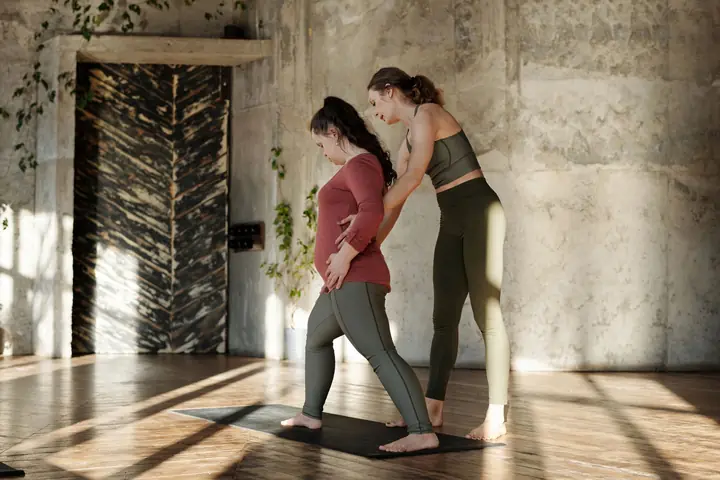 Body & HealthPracticing SafelyProtecting wrists, knees, back and shoulders in practice.
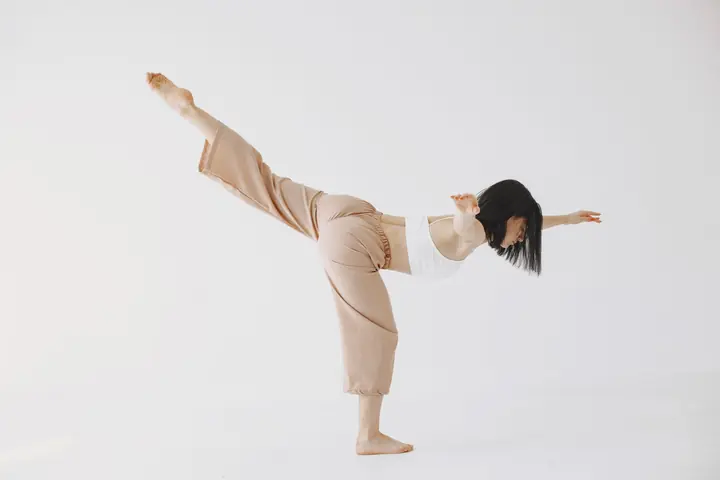 PosesPose LibraryEvery pose in the guide, filterable by type and level.
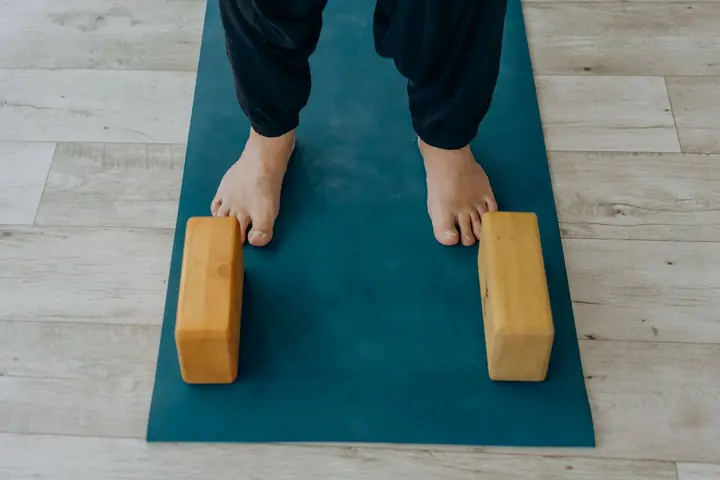 StartMats & PropsHow blocks, straps and blankets adapt poses to your body.
Sources & further reading
- B.K.S. Iyengar, Light on Yoga (1966).
- Mark Singleton, Yoga Body (2010), on the development of modern postural yoga.
- U.S. National Center for Complementary and Integrative Health (NCCIH), "Yoga: What You Need To Know."