In short
- A mat is the only thing most people need to start. Studios usually lend the rest.
- Props are tools for every level. They bring the floor closer, support the body in rest, and clarify alignment.
- On a budget, buy a mat first, then two blocks and a strap. Blankets and cushions you already own cover much of the rest.
- Clean mats and props gently and regularly; harsh chemicals shorten their life.
Why props matter
Props have a long history in modern yoga. B.K.S. Iyengar developed and popularized the systematic use of blocks, belts, blankets, bolsters, chairs and ropes, described in his teaching and books such as Light on Yoga (1966), so that students of different ages and abilities could experience the actions of a pose safely. Today props are used across almost every style.
A prop does one of three jobs. It brings the floor closer when your reach is limited, as a block under the hand in Triangle Pose does. It supports the body so muscles can release, as a bolster under the spine does in Supported Fish. Or it provides feedback and leverage, as a strap does around the foot in a seated forward fold. Using them is a sign of good practice, and many experienced practitioners use more props than beginners do.
Mats
A mat provides grip, a defined space, and a little cushioning between you and the floor. Mats differ mainly in material, thickness, size and texture.
Materials
| Material | Grip and feel | Things to know |
|---|---|---|
| PVC | Grippy when dry, durable, inexpensive | Long-lasting and easy to clean, but made from plastic that is difficult to recycle. Can feel slippery with sweat. |
| TPE (thermoplastic elastomer) | Light, soft, springy | Usually free of PVC, often cheaper and lighter. Tends to wear out faster and can dent under knees. |
| Natural rubber | Excellent grip, dense, stable | Heavy, with a rubbery smell at first. Not suitable if you have a latex allergy. Degrades in direct sunlight. |
| Polyurethane-topped rubber | Very grippy even with sweaty hands | Popular for vigorous and hot yoga. Shows marks and needs gentle cleaning. Usually more expensive. |
| Cork | Grip improves when damp; smooth, firm | Naturally resistant to odor. Usually on a rubber or TPE base. Less cushioning. |
| Cotton or jute | Textured, traditional | Cotton rugs are traditional in some styles, especially Ashtanga, often laid over a sticky mat. Jute is rough on skin but grips well. |
Thickness
Standard mats are about 3 to 5 mm thick. This range suits most people and most styles, giving enough cushioning for knees while staying stable in balance poses. Travel mats of 1 to 2 mm fold into a bag and work well over a studio mat or on carpet. Mats of 6 mm or more are kinder to sensitive knees and bony areas but can make standing balances feel less steady. If your knees are the only issue, a standard mat plus a folded blanket under the knees is often a better answer than a very thick mat.
Grip, size and texture
Grip is the most important quality for most people. Slipping hands in Downward-Facing Dog strain the wrists and shoulders. If your hands sweat, consider a rubber or polyurethane surface, or a thin towel laid over the mat. Standard mats are around 170 to 183 cm long and 61 cm wide; if you are tall, look for a longer mat so your head and feet both fit in lying poses. Some mats have alignment lines printed on them, which some people find helpful and others find distracting.
Eco considerations
No mat material is perfect. Natural rubber and cork come from renewable sources, but rubber cultivation has its own environmental impacts, and many "natural" mats have synthetic layers. PVC is durable, which reduces how often you replace it, but it is hard to recycle. The most sustainable choice is often a mat you will use for years. Look for clear information about materials and manufacturing, and when a mat wears out, consider reusing it as a garden kneeler, shelf liner or pet mat before discarding it.
Blocks
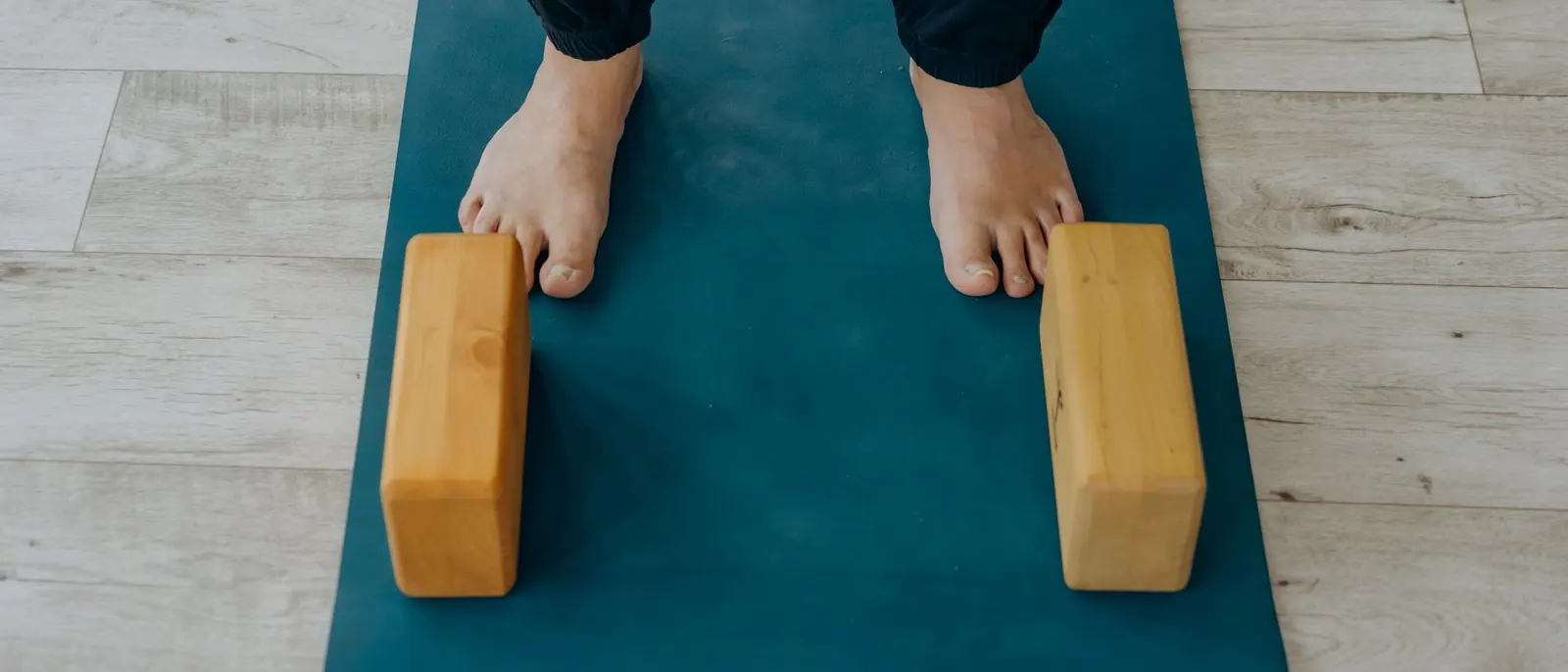
Blocks are firm rectangular supports, usually about 23 by 15 by 7.5 to 10 cm (9 by 6 by 3 to 4 inches), that can be used on three heights. They are made from foam (light, soft, inexpensive), cork (heavier, firmer, very stable) or wood (heaviest, very firm, long-lasting). Foam suits beginners and anyone who wants softer contact under the body; cork and wood are steadier when you put weight through them.
- Under the hands in standing poses: a block under the lower hand in Triangle, Extended Side Angle or Half Moon lets you keep your spine long instead of collapsing toward the floor.
- Under the hands in folds: in Pyramid Pose or Wide-Legged Forward Fold, blocks bring the floor up so you can fold from the hips.
- Under the hips when sitting: sitting on a block in Hero Pose reduces strain on the knees.
- Under the sacrum: a block under the lower back in Supported Bridge turns an active pose into a restful one.
- Between the thighs: squeezing a block in Bridge or Chair helps keep the knees in line.
- Under the head: resting the forehead on a block in Child's Pose or forward folds lets the neck relax.
Most people find two blocks the most useful number, since many poses call for one under each hand or a pair stacked.
Straps
A yoga strap (also called a belt) is a length of cotton or nylon webbing, typically 1.8 to 3 m (6 to 10 feet), with a buckle or D-rings at one end. It extends your reach and lets you hold positions without straining.
- Loop it around the feet in Seated Forward Fold or Head-to-Knee Pose to keep the spine long instead of rounding to reach the toes.
- Hold it between the hands behind the back in Cow Face Pose when the hands cannot meet.
- Lying on your back, loop it around one foot for a supine hamstring stretch, which is gentler on the lower back than a standing fold.
- Use it around the ankle in Dancer Pose or Bow Pose when you cannot reach the foot.
- Buckle it around the upper arms, just above the elbows, to keep the arms shoulder-width in Dolphin or Forearm Stand preparation.
- In restorative practice, a loop around the hips and feet holds the legs in Reclined Bound Angle.
Straps of 2.4 m (8 feet) suit most people. Taller practitioners may prefer 3 m.
Bolsters
Bolsters are firm, dense cushions, usually cylindrical or rectangular and about 60 to 70 cm long, filled with cotton batting, buckwheat hulls or foam. They are mainly used in restorative and Yin practice, where the goal is to be fully supported so the body can rest.
- Lengthwise under the spine in Supported Fish or Reclined Bound Angle to open the chest.
- Under the torso in Child's Pose so the chest and head rest completely.
- Under the knees in Corpse Pose to ease the lower back.
- Under the hips in Legs-Up-the-Wall for a gentle inversion.
- As a seat for meditation if a cushion is too low.
Rectangular bolsters are flatter and more stable; round ones give more lift. A bolster is useful but not essential. Two firmly folded blankets or a couch cushion can do the same job.
Blankets
A firm, woven blanket is one of the most versatile props. Studio blankets are often wool, cotton or a heavy synthetic weave that holds a crisp fold.
- Folded under the sitting bones in Easy Pose or Staff Pose so the pelvis tilts forward and the spine can lengthen.
- Under the knees in kneeling poses such as Camel and low lunges.
- Under the shoulders in Shoulder Stand and Plow, with the head off the edge, to reduce pressure on the neck. Learn this setup from a teacher.
- Rolled under the ankles in Hero Pose or Child's Pose if the tops of the feet ache.
- Over the body in relaxation, because body temperature drops quickly when you are still.
Eye pillows
An eye pillow is a small, soft cloth bag, often filled with flaxseed and sometimes scented, that rests over the eyes during Corpse Pose or other restorative poses. The light pressure and darkness help many people relax. It is a comfort item and entirely optional. A folded washcloth or scarf works just as well. Remove it if you feel any pressure on the eyes, and skip it if you have had recent eye surgery or have glaucoma.
Chairs and walls
A sturdy chair without wheels or arms is a valuable prop, especially for people with limited mobility, balance concerns or difficulty getting to the floor. Chair yoga adapts many poses to be done seated or standing with the chair for support. Hands on the chair back make Warrior III and Tree Pose accessible. In Iyengar yoga, specially made chairs support backbends and inversions under a teacher's guidance.
A wall is free and always available. Use it for support in balance poses, to check alignment (your back against the wall in Mountain Pose), for Legs-Up-the-Wall, and for supported variations of Half Moon with your back against it. Many teachers introduce inversions at a wall before practicing them in open space.
What to buy first on a budget
If you practice at a studio, start with nothing and use what they provide until you know what you use most. For home practice, build gradually.
A mat
A standard 4 to 5 mm mat with good grip. This is where it is worth spending a little more, since a slippery mat is frustrating and a durable one lasts years.
Two blocks
Foam is the least expensive and fine for most uses. Cork if you want more stability.
A strap
One of the cheapest props and very useful for tight hamstrings and shoulders.
Later, if you want them
A bolster for restorative practice, a meditation cushion, and an extra blanket. Only buy these if you find yourself improvising them often.
Second-hand props are fine, with one caveat. Clean them thoroughly, and inspect foam and rubber for crumbling.
Household substitutes
Almost every prop has a household equivalent. These work well while you are getting started.
| Prop | Substitute | Notes |
|---|---|---|
| Mat | Rug or carpet with a non-slip base; a towel on a wooden floor | Avoid towels on smooth floors for standing poses, as they slide. |
| Block | Thick hardcover books, a sturdy box, a stable step | Wrap books with a rubber band or tape so they do not slide apart. |
| Strap | A belt, dressing-gown cord, long scarf or towel | Avoid anything elastic, which snaps back. |
| Bolster | Two firm pillows stacked, rolled blankets, a couch cushion | Tie rolled blankets so they hold shape. |
| Blanket | Bath towels, a folded duvet, a thick sweater | Firm, flat folds work best. |
| Eye pillow | A folded washcloth, scarf or sleep mask | Keep it light. |
| Meditation cushion | Folded blankets or a firm pillow | Hips should sit slightly above the knees. |
Cleaning and care
Regular cleaning keeps equipment hygienic and extends its life.
- Mats: wipe after sweaty sessions with a damp cloth or a mild solution of water and a little gentle dish soap. Many manufacturers advise against strong cleaners, oils and alcohol, which can break down rubber and polyurethane; check the care instructions for your mat. Let it dry completely, flat or hung, before rolling. Keep natural rubber out of direct sunlight.
- Blocks: wipe foam blocks with mild soapy water. Cork and wood need only a damp cloth; avoid soaking.
- Straps and blankets: most can be machine-washed on a gentle cycle. Wool blankets usually need a cool wash or airing.
- Bolsters and eye pillows: remove and wash the cover if possible. Buckwheat and flaxseed fillings should not get wet.
- Storage: roll mats with the top surface facing out, which helps the ends lie flat. Store props in a dry place.