
In short
- Stretch and effort are normal. Sharp, pinching, electrical or joint pain is a signal to back off.
- The most commonly strained areas are the wrists, lower back, hamstring attachment, neck, knees and shoulders. Most strains come from doing too much, too soon.
- Some conditions, including high blood pressure, glaucoma, osteoporosis, hypermobility and recent surgery, call for specific modifications.
- If you are pregnant, have a medical condition or are recovering from injury, talk to your doctor and tell your teacher before class.
General principles
Serious injuries from yoga are uncommon, and the U.S. National Center for Complementary and Integrative Health (NCCIH) describes yoga as generally safe for healthy people when practiced properly under a qualified instructor. Minor strains and sprains do happen, though, and the risk rises with forceful practice, advanced poses and existing conditions. A few habits prevent most problems.
Ahimsa: non-harming
The first of Patanjali's ethical principles (yamas) is ahimsa, non-harming. It is usually discussed in relation to others, but it applies just as much to how you treat your own body on the mat. Practicing with ahimsa means working at a level of effort you can sustain, respecting the limits of the day, and letting go of the idea that a pose should look a particular way. You can read more about the ethical limbs on the Philosophy page.
Sensation versus pain
Learning to read sensations is the most important safety skill in yoga.
Usually fine
- A spreading stretch in the belly of a muscle
- Muscular effort, warmth or trembling
- Mild discomfort that eases as you breathe
- Sensations that fade soon after leaving the pose
Stop or back off
- Sharp, stabbing or pinching pain, especially in a joint
- Tingling, numbness or electrical sensations
- Pain that radiates down an arm or leg
- Pain that lingers or worsens after practice
Habits that prevent injury
- Warm up. Begin with gentle movement before deep stretches or demanding poses. The Sun Salutation is a traditional warm-up.
- Progress gradually. Increase depth, duration and difficulty over weeks. Most injuries follow a sudden jump in intensity.
- Keep breathing. If you cannot breathe smoothly in a pose, you are probably working too hard.
- Use props. Blocks, straps and blankets make poses accessible without forcing. See Mats & Props.
- Skip what does not suit you. You can always rest in Child's Pose or ask for an alternative.
- Be cautious with hands-on adjustments. You can decline adjustments at any time. A good teacher will ask first.
Common injury areas and prevention
These are the areas where yoga practitioners most often report problems. For each, the underlying cause is usually repetitive load, forcing range, or poor distribution of effort. The Anatomy & Alignment page explains how these joints move.
Wrists
Poses like plank, Downward-Facing Dog and arm balances place body weight on extended wrists, a position most people rarely load in daily life. Vinyasa classes repeat this dozens of times.
- Spread the fingers wide and press through the knuckles, especially the base of the index finger, so weight does not sink into the heel of the hand.
- Warm up the wrists with gentle circles and stretches.
- Build load gradually. Drop the knees in plank, or come onto forearms, as in Dolphin.
- A folded mat or wedge under the heels of the hands reduces wrist extension. Fists or grips are another option.
Lower back
The lower back is vulnerable in forward folds with a rounded spine, deep backbends where the bend concentrates in the lumbar spine, and forceful twists.
- In forward folds, hinge at the hips and bend the knees generously if the hamstrings are tight. Sit on a blanket in seated folds.
- In backbends, lengthen the spine first, engage the legs and buttocks moderately, and aim to arch through the upper back as well as the lower.
- Twist from the upper back, keeping the pelvis relatively stable, and avoid levering deeper with the arms.
- If you have a history of disc problems, ask a physical therapist which movements to emphasize or avoid.
Hamstring attachment
The hamstrings attach to the sitting bones (ischial tuberosities). Repeated, deep forward folds can irritate this attachment, causing a deep ache at the sitting bone, sometimes called "yoga butt" among practitioners. It tends to build slowly and can take months to resolve.
- Keep a micro-bend in the knees in forward folds rather than locking them.
- Engage the thigh muscles lightly in stretches instead of hanging passively.
- Balance stretching with hamstring strengthening, such as Bridge and Locust.
- If you feel pain at the sitting bone, reduce forward folding for a while.
Neck
The neck carries significant risk in weight-bearing inversions such as headstand, shoulder stand and plow, where body weight can load the cervical spine. It is also often overarched in backbends.
- Learn Supported Headstand and Shoulder Stand with a teacher, and build strength in preparatory poses first.
- In shoulder stand and plow, fold blankets under the shoulders so the neck keeps its natural curve, and never turn the head while inverted.
- In backbends like Camel, keep the neck long, and drop the head back only if it feels comfortable and supported.
- Skip loaded inversions if you have neck problems. Legs-up-the-Wall offers a gentle alternative.
Knees
Knees are strained most often when hip rotation is forced into the knee, as in lotus or cross-legged sitting, or when the knee collapses inward in standing poses.
- Never force lotus or half lotus. If the knee hurts, come out.
- Sit on a cushion so the knees are lower than the hips, and support raised knees with blocks or blankets.
- In lunges and standing poses, keep the front knee over the ankle and tracking toward the middle toes.
- Add a block under the hips in Hero Pose, and a blanket under the knees when kneeling.
Shoulders
Shoulder problems often come from repeated chaturanga with poor form, arm balances attempted before the strength is there, and forced binds.
- In chaturanga, keep the elbows close to the ribs and stop lowering before the shoulders dip below the elbows. Lower the knees until you have the strength.
- In Downward-Facing Dog and plank, press the floor away so the shoulder blades stay against the ribs.
- Use a strap for binds and for arms overhead or behind the back.
- Strengthen the rotator cuff and upper back, especially if you practice vinyasa frequently.
Conditions requiring care
Many people practice safely with health conditions, often with real benefit. The key is choosing suitable practices and informing your teacher. If you have any of the following, talk to your doctor about what is appropriate before you start, and look for classes described as gentle or therapeutic.
High blood pressure
Well-controlled high blood pressure is compatible with most gentle yoga. Take care with poses that place the head below the heart for long, such as headstand and extended forward folds, and with strong breath holds and forceful breathing like kapalabhati. Avoid straining or holding the breath during effort. If your blood pressure is uncontrolled, ask your doctor first. Hot yoga may also be unsuitable.
Glaucoma
Head-down positions can raise pressure inside the eye, and people with glaucoma are usually advised to avoid full inversions such as headstand and shoulder stand, and possibly other head-down positions like Downward-Facing Dog. Discuss with your eye doctor which positions are safe for you. The same applies after eye surgery or with retinal problems.
Osteoporosis and low bone density
Weight-bearing exercise is generally recommended for bone health, and standing and balance poses can contribute. The main risk is fracture of the vertebrae with loaded or forceful spinal flexion, such as deep rounded forward folds, and extreme twisting. Avoid pulling into rounded folds, keep the spine long in twists, avoid weight-bearing on the neck, and be careful with balance to reduce the risk of falls. A physical therapist can advise on the right level of loading for you.
Hypermobility
People with hypermobile joints, including those with hypermobility spectrum disorders or Ehlers-Danlos syndromes, can move easily into extreme ranges but may lack the stability to control them. Focus on strength and control in a moderate range, avoid locking joints, and be wary of passive stretching at the end of range. Poses that look easy may still be putting strain on ligaments. See flexibility, mobility and stability.
Recent surgery or injury
Get clearance from your surgeon or doctor before returning to yoga, and ask specifically which movements to avoid and for how long. After abdominal surgery, avoid strong core work, twists and forceful breathing until healed. After joint replacements, particular hip and knee positions may be off-limits. Return with a gentle or restorative practice and build gradually.
Other conditions
Heart disease, diabetes, epilepsy, disc herniation, sciatica, arthritis and mental health conditions can all be compatible with yoga but may require adaptations. When in doubt, ask your doctor and find a teacher with relevant experience.
Pregnancy and postpartum
Many people practice yoga throughout pregnancy, and prenatal yoga classes are widely available. Check with your midwife or doctor before starting or continuing, especially if your pregnancy has any complications. General guidance often includes:
- Choose prenatal classes or tell your teacher you are pregnant so they can offer alternatives.
- Avoid deep twists that compress the abdomen. Open twists, turning away from the front leg, are gentler.
- Avoid lying on the belly as pregnancy progresses, and limit lying flat on the back later in pregnancy. Use a supported incline or lie on your side.
- Avoid overstretching. The hormone relaxin increases joint laxity, so it is easier to overstretch. Stay in a comfortable range.
- Skip forceful breathing and breath holds, including kapalabhati.
- Avoid hot yoga and overheating.
- Be careful with balance as your center of gravity shifts. Use a wall or chair.
- Inversions are generally not recommended for people new to them. Experienced practitioners should discuss them with their care provider.
Stop and seek medical advice if you notice vaginal bleeding, fluid leakage, dizziness, chest pain, calf pain or swelling, contractions, or reduced fetal movement.
After birth, ask your care provider when to resume exercise, particularly after a cesarean birth or complications. Begin with gentle movement, breath and pelvic floor awareness. Some people develop a separation of the abdominal muscles (diastasis recti). If you suspect this, avoid strong core exercises and ask for an assessment, ideally with a pelvic health physical therapist.
Hot yoga considerations
Hot yoga, including Bikram and many "hot flow" classes, is practiced in rooms heated well above normal room temperature, often with high humidity. Some people enjoy the warmth and the feeling of looser muscles. The heat also introduces risks.
- Dehydration and heat illness. Drink water before, during and after. Leave the room if you feel dizzy, nauseated, confused, or stop sweating.
- Overstretching. Warm muscles may stretch further than usual, making it easier to push past safe limits.
- Heart and blood pressure. Heat increases strain on the cardiovascular system. People with heart conditions, blood pressure problems or a history of fainting should check with their doctor.
- Pregnancy. Hot yoga is generally not recommended during pregnancy because of the risks of overheating.
- Medications. Some medications affect heat tolerance or hydration. Ask your pharmacist or doctor.
If you are new to hot yoga, start with a shorter class, rest whenever you need to, and avoid comparing yourself to regulars who have acclimated.
Choosing a qualified teacher
A good teacher is one of the best safety measures available. Yoga teaching is largely unregulated in many countries, so qualifications vary widely. Some things to look for:
- Training. Many teachers complete at least a 200-hour training. Registries such as Yoga Alliance list teachers who meet their standards, but registration alone does not guarantee skill. Additional training in specific areas, such as prenatal, therapeutic or trauma-informed yoga, matters if those apply to you.
- Experience. Ask how long they have taught and whether they have worked with students like you.
- Behavior in class. A good teacher asks about injuries and conditions, offers options and modifications, asks consent before hands-on adjustments, and never pressures you to go further.
- Humility about health claims. Be cautious about teachers who promise cures or tell you to stop medical treatment.
For what to expect and how to prepare, see Your First Class and Styles of Yoga.
When to see a doctor
Consult a doctor or other health professional before starting yoga if you have a significant health condition, are pregnant, are recovering from surgery or injury, or are unsure whether yoga is appropriate for you. During or after practice, seek medical advice if you experience:
- Pain that persists for more than a few days or worsens
- Numbness, tingling or weakness in the arms or legs
- Joint swelling, instability or a sensation of something giving way
- Headaches, visual disturbances or dizziness that recur with practice
- A pop or tearing sensation followed by pain or swelling
Yoga works best as a complement to medical care. Tell your healthcare providers about your practice, and tell your yoga teacher about relevant health conditions.
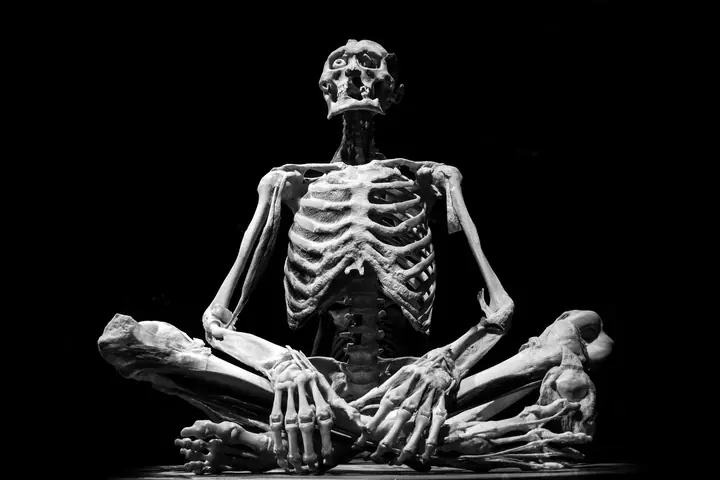 Body & HealthAnatomy & AlignmentHow the joints move and why poses look different on different bodies.
 Body & HealthBenefits of YogaWhat the research does and doesn't show.
 StartBeginner's GuideEverything to know before you begin.
Sources & further reading
- U.S. National Center for Complementary and Integrative Health (NCCIH), "Yoga: What You Need To Know" and "Yoga: Effectiveness and Safety."
- Yoga Sutras of Patanjali, II.30–35, on the yamas including ahimsa.
- B.K.S. Iyengar, Light on Yoga (1966).