In short
- You do not need to be flexible, fit or calm to start. Those qualities are what practice builds, slowly.
- A gentle, beginner-labeled Hatha or Iyengar class is the most reliable starting point for most people.
- Two or three sessions a week of 20 to 60 minutes is enough to notice real change within a couple of months.
- Progress shows up first as steadier breath, better balance and easier movement in daily life, long before any dramatic poses.
Honest expectations
Most people arrive at yoga with a picture in their head, often borrowed from photographs of very flexible people in difficult poses. It helps to set that picture aside. Yoga as it is practiced in most classes today is a combination of postures (asana), breathing practices (pranayama) and some form of rest or meditation. The postures are the part people notice, but they are only one strand of a much older tradition, described on What Is Yoga? and Philosophy & the Eight Limbs.
Your first sessions will probably feel awkward. You will be told to do several things at once, such as breathe through your nose, keep your knee over your ankle and relax your shoulders, and you will manage perhaps one of them. That is normal. Coordination between breath and movement is a skill, and like any skill it takes repetition.
You may also feel some muscle soreness a day or two after your first classes, especially in the legs, hips, shoulders and the backs of the thighs. Mild soreness that fades within a few days is ordinary. Sharp pain during a pose, pain in a joint, or pain that lingers is a signal to back off and, if it persists, to get advice.
What yoga can reasonably offer is well documented in general terms. Research summarized by the U.S. National Center for Complementary and Integrative Health (NCCIH) suggests yoga may help with stress, sleep, balance and some kinds of low-back and neck pain, and that it is generally safe when practiced with appropriate guidance. It is not a cure for disease and it is not a replacement for medical care. The Benefits of Yoga page covers the evidence in more detail.
Choosing a style and a class
The word "yoga" on a studio schedule covers a wide range of classes. Some are slow and detailed, some are brisk and sweaty, and some are almost entirely lying down. The Styles of Yoga page explains each one in depth. For a first choice, the pace of the class and the quality of instruction matter more than the name of the style.
| Style | Pace | Good first choice if you |
|---|---|---|
| Hatha (beginner or gentle) | Slow to moderate | Want a balanced introduction to common poses and breathing. |
| Iyengar | Slow, precise | Like clear alignment instruction and plenty of props; helpful with stiffness or old injuries. |
| Vinyasa (level 1 or "slow flow") | Moderate | Are fairly active and enjoy continuous movement linked to breath. |
| Restorative | Very slow | Mainly want rest and stress relief, or are recovering from illness. |
| Yin | Slow, long holds | Want quiet, passive stretching; best alongside a more active class. |
| Ashtanga, power, hot | Fast or demanding | Already have a good fitness base. Most beginners are better served starting elsewhere. |
Look for the words "beginner," "foundations," "level 1," "gentle" or "intro" on the schedule. Many studios run a multi-week beginner course, which is often the best value because each session builds on the last and the teacher learns your name and your body. Community centers, gyms and libraries also run good low-cost classes. Your First Class explains what to expect when you walk in.
What makes a good beginner teacher
A good teacher gives clear instructions, offers variations without making you ask, watches the room, and asks about injuries before class. They should be comfortable saying "skip this one" or "try it with a block." Credentials vary widely. Many teachers hold a 200-hour training registration, which is a reasonable baseline but says little about experience. Years of teaching and how you feel in the class are better guides.
How often and how long
Frequency matters more than duration. The body adapts to what it does regularly, so three 20-minute sessions in a week will usually do more for you than a single 90-minute class.
- Minimum that helps: one class a week plus one or two short sessions at home.
- A solid routine: two or three sessions a week, 30 to 60 minutes each.
- Daily practice: possible and valuable, but vary the intensity. A daily habit of 10 to 15 minutes, with longer sessions two or three times a week, is sustainable for most people.
Rest days are part of training. If you do more vigorous styles, alternate them with gentler sessions, walking or restorative work. For ideas on short sessions you can do on your own, see Practicing at Home.
The first weeks
During the first month the main task is learning the vocabulary. You will meet the same dozen or so poses again and again: Mountain Pose, Downward-Facing Dog, Child's Pose, Warrior II, Cobra, Tree and a few seated stretches. Once the shapes are familiar, your attention can move from "what am I supposed to be doing" to "how does this feel."
Weeks one and two
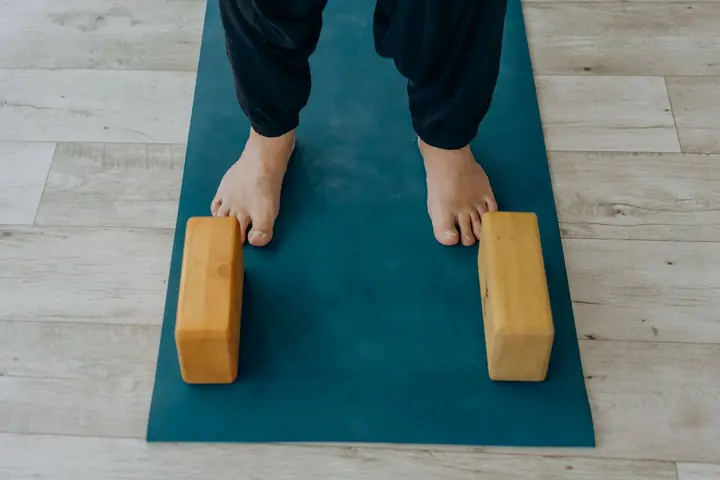
Focus on breathing steadily through the nose, following instructions, and resting whenever you need to. Use props freely. A block under your hand in a standing pose or a folded blanket under your hips in a seated pose puts you in the position the pose is designed to create. See Mats & Props.
Weeks three and four
Start noticing your habits. Perhaps you lock your knees when standing, hold your breath in balances, or hunch your shoulders in Downward Dog. Pick one habit at a time and work on it. Try one or two short sessions at home, even ten minutes, to reinforce what you learned in class.
Weeks five to eight
Poses that felt impossible may now feel merely difficult. Sun Salutations, if your classes use them, begin to flow. This is a good time to learn more about the breath (Breathwork) and to try a few minutes of sitting quietly after practice (Meditation).
What progress actually looks like
Progress in yoga is gradual and often shows up outside the practice before it shows up in it. Typical early signs include:
- Your breath stays smooth in poses where you used to hold it.
- You can stand on one leg for longer without wobbling or grabbing the wall.
- Getting up from the floor, reaching a high shelf or tying your shoes feels easier.
- You notice tension in your shoulders or jaw during the day and can let some of it go.
- You fall asleep a little more easily after an evening session.
Flexibility changes more slowly than most people expect. Hamstrings and hips may take months to change noticeably, and some limits are set by bone structure and cannot be stretched away. Two people with the same dedication can look very different in the same pose, which is one reason teachers increasingly focus on how a pose functions rather than how it looks. The Anatomy & Alignment page explains why.
A gentle first 15-minute routine
This routine uses only beginner poses and needs nothing more than a mat or a folded blanket on a non-slip floor. Move slowly, breathe through the nose if you can, and stop anything that causes sharp or joint pain. Each pose name links to full instructions.
- 1 minEasy PoseSit cross-legged on a folded blanket. Lengthen your spine and let your breath slow down.
- 1 minCat-CowOn hands and knees, arch and round the spine with the breath: inhale to lift the chest, exhale to round the back.
- 1 minChild's PoseKnees wide, big toes together, forehead on the mat or a block. Breathe into your back.
- 1 minDownward-Facing DogKnees bent generously, heels lifted. Press the floor away and lengthen your spine. Rest in Child's Pose if needed.
- 1 minMountain PoseWalk to the front of the mat and stand tall. Feet hip-width, weight even, arms relaxed.
- 2 minWarrior IIAbout 30 seconds per side, twice. Front knee over the ankle, arms wide, gaze over the front hand.
- 2 minTree PoseOne minute per side. Foot on the ankle or inner calf, never pressed into the knee. Use a wall for support.
- 1 minSphinx PoseLie on your front, elbows under shoulders. Lift the chest gently and keep the lower back comfortable.
- 1 minBridge PoseLie on your back, knees bent. Lift the hips for three or four slow breaths, lower, and repeat twice.
- 1 minReclining TwistKnees fall to one side, shoulders stay heavy. Thirty seconds each way.
- 3 minCorpse PoseLie flat, arms relaxed, eyes closed. Let the breath be natural. Roll to one side before sitting up.
Once this feels comfortable, try the longer routines on Practicing at Home, or learn a Sun Salutation to use as a warm-up.
Common beginner mistakes
Do
- Bend your knees in forward folds and Downward Dog.
- Use blocks, straps and blankets from the first day.
- Keep breathing, even if the breath is short.
- Rest in Child's Pose whenever you need to.
- Tell the teacher about injuries and conditions.
- Work at about 70 percent of your maximum effort.
Avoid
- Copying the most flexible person in the room.
- Locking your knees or elbows straight.
- Holding your breath in balances and strength poses.
- Forcing range in the neck, knees or lower back.
- Eating a large meal right before practice.
- Skipping the rest at the end of class.
The most common mistake of all is pushing too hard. Yoga rewards patience. The sensation to look for is a clear stretch or effort in the muscles, with breath you can still control. Pain in joints, tingling, numbness or pinching means stop and adjust. Practicing Safely covers warning signs in more detail.
A second common mistake is comparing yourself to others. Proportions, bone shape and history differ from person to person. The version of a pose that suits your body is the correct one for you.
Next steps
Once you have a few weeks of regular practice behind you, you can start to deepen it in several directions. Learn the poses more thoroughly through the Pose Library. Build a short home routine. Explore breathing and meditation, which many long-term practitioners consider the heart of the practice. If you are curious about where all this came from, read History of Yoga.