In short
- A Sun Salutation is a repeating flow of standing, folding, plank and backbend positions, with one breath per movement.
- Surya Namaskar A is the basic version. Surya Namaskar B adds Chair Pose and Warrior I and asks for more stamina.
- Beginners can start with a half salutation that stays on the feet, then add the floor work with knees down.
- Move at the speed of your breath. If you have to rush or hold your breath to keep up, slow down or simplify.
What a Sun Salutation is
A Sun Salutation is a short sequence of postures performed as one continuous movement. Each shift from one shape to the next happens on a single inhale or exhale, so the sequence works as a moving breathing exercise as much as a stretch. Many classes open with three to five rounds to warm the spine, hips, shoulders and hamstrings before holding poses for longer.
The name comes from surya (sun) and namaskar (greeting or salutation). Prostrations to the sun have a long devotional history in India, but historians generally treat the sequence taught in studios today as a modern development. Mark Singleton's Yoga Body (2010) traces how Surya Namaskar was promoted as a physical fitness routine in the early twentieth century, notably by the Raja of Aundh, and how it entered the teaching of T. Krishnamacharya in Mysore. The version below follows the form that reached a wide audience through Krishnamacharya's student K. Pattabhi Jois and Ashtanga Vinyasa yoga. Other lineages, such as Sivananda yoga, teach a twelve-position version that includes low lunges. Neither is more correct; they are different traditions. See History of Yoga and Styles of Yoga for context.
Linking breath and movement
The organizing rule is simple. Movements that open the front of the body and lift the chest go with the inhale. Movements that fold, lower or ground go with the exhale. Raising the arms, lifting halfway and rising into a backbend are inhales. Folding forward, lowering to the floor and pressing back into Downward-Facing Dog are exhales.
Breathe through the nose if you comfortably can. Many teachers use ujjayi, a slightly audible breath made by gently narrowing the back of the throat, because the sound makes the breath easy to follow and to keep even. It is optional. A smooth, unforced nasal breath is enough. The Breathwork page explains ujjayi in more detail.
Start each movement with the breath and finish the movement as the breath finishes. This is harder than it sounds. Most people move first and breathe afterward, or hold their breath through the transition to plank. If that happens, the sequence is too fast or too demanding for now.
Surya Namaskar A, step by step
Stand at the front of your mat, feet together or hip-width apart. One full round has eleven positions, and it returns you to where you began. Learn it slowly the first few times, pausing in each position for an extra breath if you need one.
Stand in Mountain Pose (exhale)
Stand tall in Mountain Pose (Tadasana, called Samasthiti in Ashtanga). Weight even across both feet, arms by your sides, gaze level. Take a full exhale to begin.
Arms up (inhale)
Sweep the arms out to the sides and overhead, palms meeting or shoulder-width apart. This is Urdhva Hastasana, Upward Salute. Keep the lower ribs soft rather than flaring them forward. Look up toward the thumbs only if the neck is comfortable.
Forward fold (exhale)
Hinge at the hips and fold forward into Uttanasana. Bend the knees as much as you need to bring the hands to the floor, shins or blocks. Let the head hang.
Halfway lift (inhale)
Press the hands into the shins or floor and lengthen the spine forward so the back is long and roughly flat. This is Ardha Uttanasana. Draw the shoulders away from the ears and keep the back of the neck long.
Step back and lower (exhale)
Plant the hands, step or hop back to plank, then lower halfway into Chaturanga Dandasana, Four-Limbed Staff Pose, with elbows hugging the ribs. Beginners lower the knees first and bring the chest down to the floor. Stepping back to plank can take its own breath while you learn.
Upward-Facing Dog or Cobra (inhale)
Pull the chest forward and up. In Upward-Facing Dog the arms straighten and the thighs lift off the floor, with the tops of the feet pressing down. In Cobra the legs and pelvis stay down and the elbows stay bent. Cobra is the better choice for most beginners.
Downward-Facing Dog (exhale, then stay 5 breaths)
Tuck the toes, lift the hips up and back into Downward-Facing Dog. Hands shoulder-width, feet hip-width, knees bent as needed so the spine can lengthen. Stay for five slow breaths.
Step forward and lift halfway (inhale)
At the end of the last exhale, look toward the hands, bend the knees and step or hop the feet between the hands. Inhale into the halfway lift, long spine, hands on shins or floor. If the step needs more than one breath, take small steps and let the breath catch up.
Forward fold (exhale)
Release back down into Uttanasana, knees bent as much as you like.
Rise with arms up (inhale)
Press through the feet and come all the way up, sweeping the arms out and overhead. Bend the knees and keep the back long as you rise if the lower back is sensitive.
Return to Mountain Pose (exhale)
Lower the arms to the sides, or bring the palms together at the chest. Stand for a breath before starting the next round.
Surya Namaskar B in brief
Surya Namaskar B uses the same frame and adds two standing poses, which makes each round roughly twice as long and considerably more demanding on the legs. In Ashtanga counting, A has nine numbered movements and B has seventeen. It is usually practiced after a few rounds of A.
- InhaleChair PoseBend the knees and sweep the arms up into Chair Pose (Utkatasana).
- ExhaleForward foldStraighten the legs as much as is comfortable and fold.
- InhaleHalfway liftLong spine, hands on shins or floor.
- Exhale / InhaleChaturanga, then Up Dog or CobraAs in Surya Namaskar A.
- ExhaleDownward-Facing DogTurn the left heel in slightly as you arrive.
- InhaleWarrior I, right sideStep the right foot forward, bend the right knee and rise into Warrior I.
- Exhale / Inhale / ExhaleVinyasaHands down, step back, Chaturanga, Up Dog or Cobra, Downward-Facing Dog.
- InhaleWarrior I, left sideStep the left foot forward and rise.
- Exhale / Inhale / ExhaleVinyasa to Downward-Facing DogStay five breaths in Downward-Facing Dog.
- Inhale / ExhaleHalfway lift, then foldStep or hop forward.
- Inhale / ExhaleChair Pose, then Mountain PoseRise into Chair, then straighten the legs and lower the arms.
The step from Downward-Facing Dog into Warrior I is the hardest part for most people. It is fine to bring the knee down, step the foot forward with help from the hand, then rise.
A beginner-friendly half salutation
A half Sun Salutation (Ardha Surya Namaskar) keeps you on your feet. It is a good way to learn the breath pattern, to warm up on days when the wrists or shoulders need a rest, and to start a practice gently in the morning.
Mountain Pose (exhale)
Stand tall, feet hip-width apart, arms by your sides.
Arms up (inhale)
Sweep the arms overhead.
Fold with bent knees (exhale)
Hinge forward, knees soft, hands to shins, blocks or floor.
Halfway lift (inhale)
Hands on shins or thighs, lengthen the spine forward.
Fold (exhale)
Release down again.
Rise (inhale)
Come up with a long back, arms sweeping overhead.
Mountain Pose (exhale)
Lower the arms. Repeat three to six times.
Once this feels natural, add a knees-down trip to the floor between the halfway lift and the rise. Step back to plank, lower the knees, lower the chest, inhale into a low Cobra, exhale to Child's Pose or Downward-Facing Dog, then walk forward.
Pace and number of rounds
There is no fixed speed. Your breath sets it. For most people a comfortable breath is somewhere between three and six seconds per inhale or exhale, which makes one round of A take roughly a minute including the five breaths in Downward-Facing Dog.
- Learning: one or two rounds, adding extra breaths in any position.
- Warm-up before a class or home practice: three rounds of A, then two or three of B if you practice a vigorous style.
- As a practice in itself: five to twelve rounds, followed by a few minutes lying down in Corpse Pose.
Some traditions practice 108 rounds on special occasions such as the solstices. That is a feat of endurance and not a daily target.
Common errors
Try to
- Bend the knees in every fold so the spine stays long.
- Lower from plank with the elbows close to the ribs and the body in one line.
- Keep the shoulders drawn away from the ears in Cobra and Up Dog.
- Let the breath lead and the body follow.
- Spread the fingers wide and press through the knuckles to protect the wrists.
Avoid
- Collapsing the hips in Chaturanga so the lower back sags.
- Dropping the shoulders below the elbows when lowering.
- Crunching into the lower back in Up Dog with the thighs on the floor.
- Holding the breath while stepping back or forward.
- Rushing to finish more rounds at the cost of control.
Modifications and props
Knees down
Lower the knees before you lower the chest. You can bring the chest and chin to the floor with the hips lifted (the "knees, chest, chin" position used in many classes), or lower in one line from a knees-down plank. Both build the same pressing strength as full Chaturanga with less load.
Blocks
Place two blocks at the front of the mat, shoulder-width apart. Bring the hands to the blocks in the forward fold and halfway lift so you can keep the spine long with tight hamstrings. Blocks under the hands in Downward-Facing Dog can also ease pressure on the wrists. See Mats & Props.
Wrist-friendly options
Make fists and rest on the knuckles, or come onto the forearms and replace Downward-Facing Dog with Dolphin Pose. The standing half salutation avoids weight on the hands entirely.
Chair or wall
If getting to the floor is difficult, practice the half salutation with the hands on the seat of a sturdy chair or on a wall at hip height for the fold and halfway lift.
Cautions
In pregnancy, many teachers suggest widening the feet, skipping Chaturanga and deep backbends, and replacing the floor section with a knees-down variation or the standing half salutation. After abdominal surgery or with a diagnosed disc problem, check with your doctor or physiotherapist before practicing flowing sequences.
Related pages
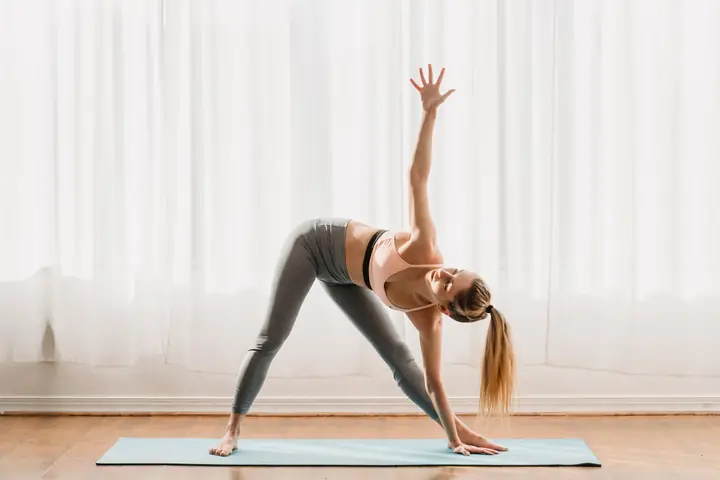 PosesStanding PosesMountain, Chair and Warrior I in detail, the standing shapes inside the salutations.
 PosesInversionsA full guide to Downward-Facing Dog and its variations.
 PosesBackbendsCobra and Upward-Facing Dog, and how to tell them apart.
 Breath & MindBreathworkUjjayi and other techniques that support moving with the breath.
 StartPracticing at HomeHow to build Sun Salutations into a short daily routine.